
Introduction
In the early summer of 1886, two bodies were found floating in the shallow waters of Lake Starnberg, Bavaria. One belonged to the deposed King Ludwig II, age 40. The other was his personal physician and court-appointed psychiatrist, Dr. Bernhard von Gudden. Neither man had visible wounds. No autopsy was performed. No public inquiry was held.
It was the end of a reign—but the beginning of a mystery that still refuses to rest.
To the public, Ludwig remains the “Fairy Tale King,” the misunderstood dreamer whose castles now grace puzzles, travel brochures, and royal legends. But beneath that romantic image lies a darker truth: Ludwig II was a sovereign systematically isolated, diagnosed without direct examination, and ultimately removed by his own ministers.
What truly happened to Ludwig? Was he mentally ill—or politically inconvenient? Did he drown alone—or did someone make sure he would never resurface?
This Curianic investigation revisits the final years of Ludwig’s life, not to offer conspiracy, but to trace the fractures between fact, rumor, and power. What emerges is not merely the story of a fallen monarch, but a cautionary tale about what happens when private vision challenges public rule.
I. A Monarch of Another Kind
Born in 1845, Ludwig ascended to the Bavarian throne at just 18. As a boy, Ludwig was known for his imagination, love of medieval tales, and reclusive nature—traits that only deepened after his father’s death. His rule began in an era of growing Prussian dominance and shrinking regional autonomy. Unlike his predecessors, Ludwig had little interest in military affairs or parliamentary politics. He communicated with ministers by note, withdrew from public events, and showed an intense emotional interiority rare in 19th-century monarchs.
His greatest obsession was not governance, but art—especially the operas of Richard Wagner. Ludwig saw in Wagner a prophet of myth and emotion. He became Wagner’s patron, rescuing him from exile, funding his work, and envisioning his mythic operas as the guiding spirit of Bavaria.
Their relationship was emotionally intense, possibly romantic on Ludwig’s side, and rich with symbolism—Wagner represented the idealized spirit of art, of legend, of pure beauty. But over time, Wagner’s ambitions grew: he meddled in court politics, attracted scandal with his affair with Cosima von Bülow, and alienated ministers who saw him as a threat. Under pressure, Ludwig was forced to distance himself.
Though Wagner left Munich, Ludwig’s devotion never faltered. He funded the Bayreuth Festival Theatre and wrote to Wagner with poetic longing. When Wagner died in 1883, Ludwig wore black and mourned like a widow. The composer was gone, but his music echoed through every stone Ludwig laid.
Neuschwanstein, Linderhof, and Herrenchiemsee were not built to govern—they were realms of retreat. They were Wagnerian dreamscapes, meant not for courts, but for solitude.
“These castles,” Ludwig once wrote, “are the only things that make life bearable.”
But while the king built his inner world in stone, the outer world—his government—grew concerned.
II. The Kingdom of Solitude
Ludwig increasingly retreated from court life. He rarely held councils. Servants were instructed not to look at him. He lived largely at night. Ministers reported erratic spending, emotional letters, and strange behaviors. His private life attracted attention—especially his emotional attachments to male servants and court actors, and the one engagement he never fulfilled.
That engagement, in 1867, was to Duchess Sophie Charlotte, the youngest sister of Empress Elisabeth of Austria—Sisi. It was the only official romantic commitment of Ludwig’s life. The match was arranged, politically ideal, and welcomed by the public. But Ludwig postponed the wedding again and again.
He admired Sophie, perhaps even cared for her, but in his own words: “I do not love her.” Eventually, he broke the engagement, sparking scandal and questions about his personal life. Many now believe the engagement was Ludwig’s attempt to satisfy dynastic duty while his heart remained unreachable.
His emotional anchor, meanwhile, was Sisi, his cousin and kindred spirit. They shared a bond of poetic melancholy, intellectual intimacy, and mutual detachment from royal obligations. Sisi—trapped in her own imperial cage—understood Ludwig. He called her the only person who truly did. They escaped together in long walks, midnight conversations, and letters steeped in sorrow.
Sisi was devastated by Ludwig’s death. Though she would officially enter mourning attire after the suicide of her son Rudolf in 1889, many accounts suggest that Ludwig’s passing three years earlier profoundly shook her. In private notes, she called him a soul“too fragile for this world”, and his loss deepened her retreat from court life.
As Ludwig’s emotional withdrawal deepened, so too did the tension with his government. But it wasn’t only his solitude that alarmed them. It was the finances.
Ludwig’s castles were astonishingly expensive. His debts soared into the millions of marks. Ministers feared national bankruptcy. They saw his refusal to prioritize military or economic modernization as dangerous. Other monarchs built palaces, yes—but Ludwig had no interest in balancing dreams with duty.
He rejected diplomacy. He ignored cabinet proposals. He treated the monarchy not as administration—but as a stage.
Behind the scenes, ministers began to see a king whose vision was not only eccentric—but incompatible with the future they imagined for Bavaria. More than a financial liability, he became a political risk: erratic, emotionally opaque, and symbolically out of step with Germany’s growing unification.
III. The Doctor and the Declaration
Dr. Bernhard von Gudden, a respected psychiatrist, had long advised the court. In June 1886, he led a panel that declared Ludwig clinically insane—without a single direct examination. The diagnosis, based on interviews with servants and ministers, cleared the way for Ludwig’s deposition.
Von Gudden may have believed he was serving the state. Others suggest he was pressured into legitimizing a political removal. Still others wonder whether his role was more intimate: a confidant turned enforcer, privy to Ludwig’s deepest fears and private identity.
On June 13, von Gudden accompanied Ludwig on an evening walk along Lake Starnberg. They were alone. Hours later, both were dead.
No one knows what truly happened. Theories vary:
- That Ludwig, a strong swimmer, drowned himself and von Gudden tried to intervene.
- That Ludwig, in despair or anger, attacked the doctor.
- Or that both were silenced by those with more to lose.
There was bruising on Ludwig’s neck. Von Gudden’s face was reportedly battered. The water was shallow. No autopsies were performed.
That night, a fog had rolled over Lake Starnberg like a curtain descending upon a stage. Locals later said the swans had vanished from the shoreline earlier that evening—an ill omen. One swan, however, was seen gliding silently through the mist just before dawn, alone and unafraid. It passed the reeds near the shore, then vanished into the fog.
To Bavarians, the swan was Ludwig’s chosen emblem—purity, solitude, tragic loyalty. The appearance of a lone swan, just before the discovery of the bodies, became a quiet legend whispered through generations. Some say the king followed it. Others say it came to guide him home.
IV. After the Silence
The monarchy moved swiftly. Ludwig was buried with ceremony. He was buried in the royal crypt at St. Michael’s Church in Munich, beneath a tomb marked with only his name and dates—a modest resting place for a man of such dreams. His diagnosis was confirmed publicly. His younger brother Otto—long known for his psychological fragility—was declared mentally unfit and placed under permanent guardianship. He would live the rest of his life in confinement, never ruling in his own name.
With Otto declared unfit to rule, power passed to their uncle, Prince Luitpold, who assumed the role of Prince Regent. A figure of quiet authority and conventional politics, Luitpold represented everything Ludwig was not: cautious, pragmatic, and deferential to ministerial rule. His son, Prince Ludwig, would later become the final King of Bavaria—ushering in a short-lived return to traditional monarchy before the kingdom’s dissolution in 1918. Between them, the uncle and cousin stabilized the throne by erasing its most visionary heir.
The Wittelsbach line thus continued under regency, but the monarchy itself was weakened. Within decades, Bavaria would be absorbed into the German Empire, and the old world Ludwig tried to preserve would vanish.
Yet Ludwig’s legacy escaped their control.
Neuschwanstein, once mocked as wasteful, became one of the most visited castles in the world. It directly inspired Walt Disney’s Sleeping Beauty Castle and later fantasy architecture across media. Linderhof and Herrenchiemsee, though smaller in scale, became pilgrimage sites for those drawn to beauty, solitude, and lost grandeur.
Today, these structures are more than monuments. They are testaments to what Ludwig valued: imagination, emotion, and the inner world.
V. What Remains
Was Ludwig II mad? Or was he a ruler whose refusal to conform—to marry, to militarize, to modernize—was too radical for his time?
Perhaps the better question is not how he died, but what he endangered:
- A political system built on discipline, not dreams.
- A monarchy uncomfortable with emotional complexity.
- A culture that punished beauty when it came at the cost of order.
He left no heirs. But he left a myth. And unlike the political structures that erased him, that myth continues to rise in stone.
Appendix: The Palaces of Ludwig II
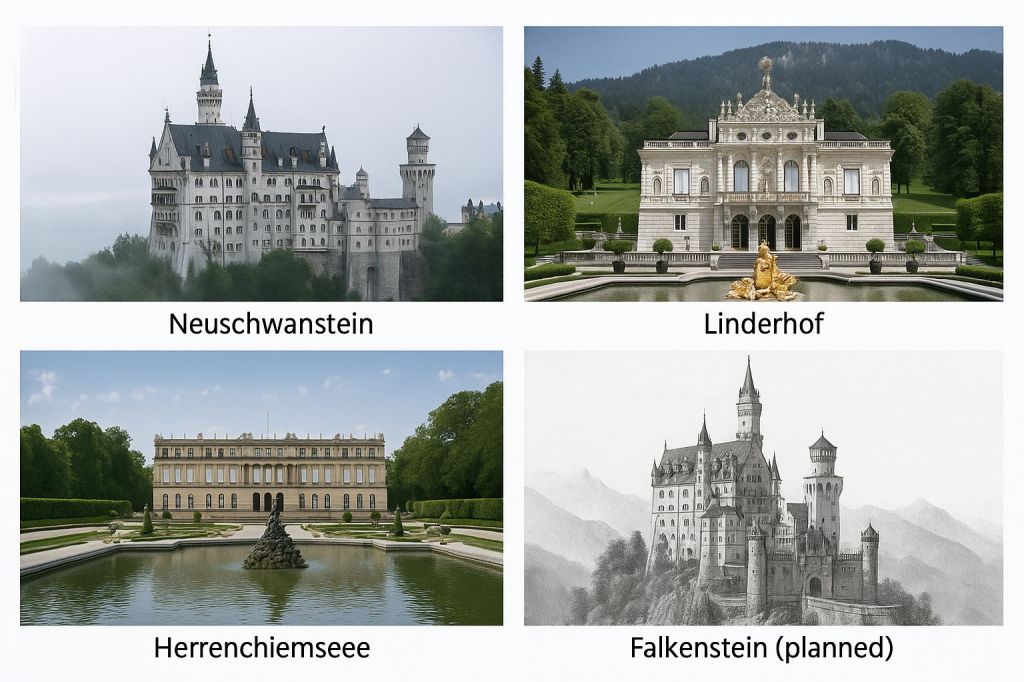
Neuschwanstein Castle
Built in honor of Wagnerian mythology, its soaring turrets and remote alpine setting made it the prototype for Disney’s fantasy castles. Never completed, it is now one of the most visited landmarks in Europe.
Linderhof Palace
The only palace Ludwig saw completed. Small but lavish, it features mirrored salons, operatic lighting, and an underground grotto lit by colored lights for private Wagner performances.
Herrenchiemsee Palace
An unfinished replica of Versailles on an island in Lake Chiemsee. A monument to Ludwig’s love of absolutist splendor, yet left incomplete.
Falkenstein Castle (planned)
A dramatic fortress sketched for a remote mountain cliff. It was never built, surviving only in Ludwig’s drawings and dreams.
Private Chambers and Theatrical Interiors
Throughout his residences, Ludwig installed mirrored walls, rising dining tables, and atmospheric lighting meant to evoke stage design. These were not just palaces, but immersive emotional landscapes.
Image Credits
Castle photos adapted from public domain and historical archives, including Neuschwanstein, Linderhof, and Herrenchiemsee.
The rendering of Falkenstein is based on 19th-century conceptual drawings and may reflect similarities to Neuschwanstein due to shared architectural vision. Collage created and curated by Curianic.
Curianic Opinion
Ludwig II built no empire. He won no wars. But his refusal to obey the conventions of kingship—his insistence on vision over power—made him unforgettable. In the end, he ruled only the realm of dreams. And perhaps, that was the point.