Choosing where to study abroad after high school is one of the biggest decisions a student can make. It’s not just about the degree — it’s about building a future.
In 2025, international students are looking for countries that offer affordable education, post-study work visas, strong job markets, and the chance to build a long-term career.
This guide compares the best countries to study abroad based on tuition fees, visa policies, cost of living, university rankings, visa costs, proof of funds, and career opportunities.
Country Comparison Table
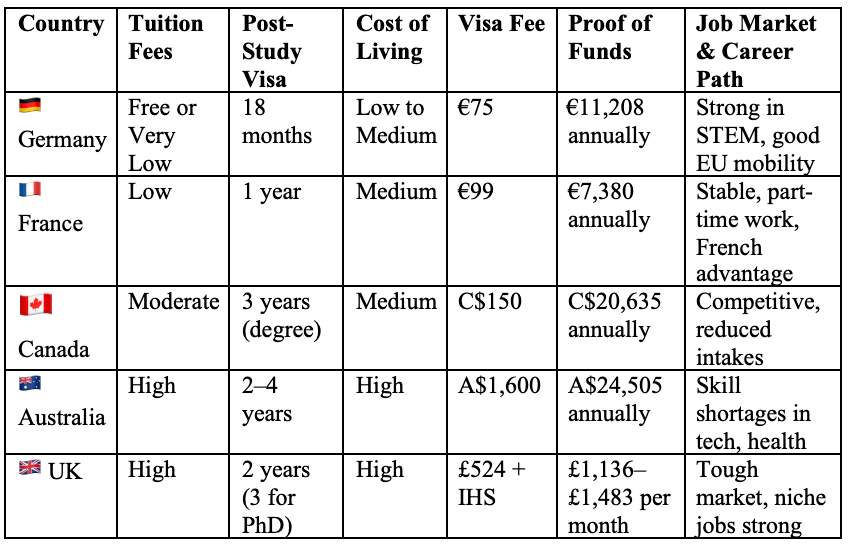
🇩🇪 Germany: Low Cost, Strong Careers
(Source: DAAD – Cost of Living & Tuition, Federal Foreign Office – Visa Fees & Requirements)
Tuition and Living Costs
- Tuition Fees: Free or very low at public universities.
- Living Costs: Low to medium.
Visa Fee and Financial Proof
- Visa Fee: €75 (~US$80).
- Proof of Funds: €11,208 per year in a blocked account.
Post-Study Visa
- 18 months job search visa after graduation.
- Good chance to secure the EU Blue Card (a long-term residence permit).
Job Market (2025 Reality)
- High demand in STEM fields (engineering, automotive, IT).
- German language skills are highly recommended to increase employment chances.
Top Fields
Engineering, automotive, IT, manufacturing, natural sciences.
Why Choose Germany?
– Free or low-cost education
– Low visa cost and proof requirement
– Strong career prospects in STEM
– Pathways to long-term EU residency
– No intake caps
🇫🇷 France: Affordable and Accessible
(Source: Campus France – Cost of Living & Tuition Fees, Étudiant-gouv – Tuition Fees in Public Institutions)
Tuition and Living Costs
- Tuition Fees: Approx. €4,000–€10,000 per year.
- Living Costs: Medium (cheaper outside Paris).
Visa Fee and Financial Proof
- Visa Fee: €99 (~US$105).
- Proof of Funds: Approx. €7,380 per year.
Post-Study Visa
- 1-year visa to search for a job after graduation.
Job Market (2025 Reality)
- Stable employment market.
- Part-time work allowed during studies.
- Full-time job opportunities stronger for French speakers.
Top Fields
Business, fashion, hospitality, engineering, arts.
Why Choose France?
– Low tuition fees and visa cost
– Lowest financial proof requirement
– Part-time work allowed
– Accessible visa system
– No intake caps
🇨🇦 Canada: Strong Opportunities, Tighter Access
(Source:Government of Canada – Study Permit Requirements)
Tuition and Living Costs
- Tuition Fees: Approx. C$15,000–C$30,000 per year.
- Living Costs: Medium.
Visa Fee and Financial Proof
- Visa Fee: C$150 (~US$110).
- Proof of Funds: C$20,635 annually.
Post-Study Visa
- Degree Programs: Eligible for 3-year Post-Graduation Work Permit (PGWP).
- Diploma/Certificate Programs: Must be among 920 approved fields (updated in 2025).
Job Market (2025 Reality)
- Youth unemployment recently reached 11.2%.
- Permit issuances dropped ~39% in 2024.
- Employment rate for graduates is 88.6%, with lower average wages than locals.
Top Fields
IT, engineering, healthcare, education, business.
Why Choose Canada?
– Strong post-study visa (3 years)
– Clear permanent residency pathways
– Multicultural environment
– Increased competitiveness and stricter requirements
🇦🇺 Australia: Rising Costs, Competitive Access
(Source: Australian Department of Home Affairs – Student Visa (Subclass 500))
Tuition and Living Costs
- Tuition Fees: Approx. A$20,000–A$45,000 per year.
- Living Costs: High.
Visa Fee and Financial Proof
- Visa Fee: A$1,600 (~US$1,000), increasing to A$2,000.
- Proof of Funds: A$24,505 annually.
Post-Study Visa
- Temporary Graduate Visa: 2–4 years depending on degree and location.
- Permanent residency possible via skilled migration.
Job Market (2025 Reality)
- Growing demand in healthcare, construction, IT, and education.
- Some graduates face underemployment without additional certifications.
- Student intake capped at 270,000 commencements in 2025.
Top Fields
Nursing, IT, engineering, education, skilled trades.
Why Choose Australia?
– Long post-study visa options
– Excellent student support systems
– Rising visa costs and limited intakes
– Requires proactive skill-building
🇬🇧 UK: Prestige with High Costs
(Source: UK Government – Student Visa)
Tuition and Living Costs
- Tuition Fees: Approx. £20,000–£40,000 per year.
- Living Costs: High, especially in London.
Visa Fee and Financial Proof
- Visa Fee: £524 (~US$620) plus health surcharge (IHS).
- Proof of Funds: £1,136–£1,483 per month for living.
Post-Study Visa
- Graduate Route Visa: 2 years (3 years for PhD graduates).
Job Market (2025 Reality)
- Graduate job postings are 33% lower compared to previous years.
- Finance, engineering, law, and IT remain competitive.
Top Fields
Finance, law, engineering, medicine, creative industries.
Why Choose the UK?
– Prestigious universities
– Strong niche job markets
– Expensive visa and health fee
– Competitive job environment
Job Market Verdict
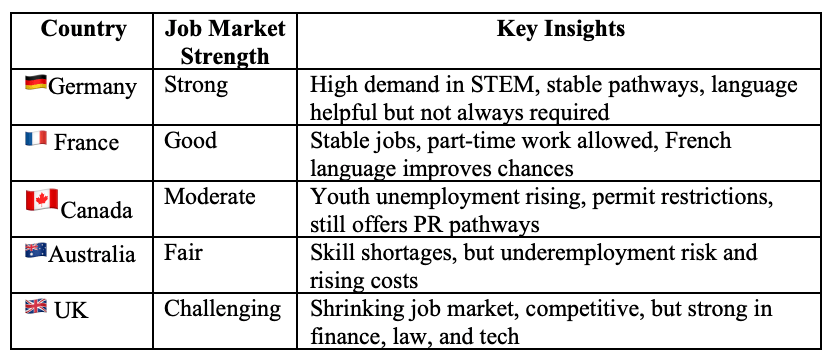
Final Comparison: Best Choice in 2025
- 🇩🇪 Germany: Best for students seeking free tuition, low visa costs, low financial proof, and STEM careers.
- 🇫🇷 France: Best for budget-conscious students needing the lowest financial proof and visa fees.
- 🇨🇦 Canada: Best for students who want a long visa and clear PR pathway, but now with higher proof and stricter intake.
- 🇦🇺 Australia: Great for students targeting skill shortages, but rising visa costs and intake caps lower accessibility.
- 🇬🇧 UK: Ideal for students aiming for global universities but prepared to handle high costs and tough competition.
Final Thoughts: Where Your Future Begins
Germany and France now offer the most accessible and affordable study destinations in 2025. Canada remains a solid choice, but stricter policies and higher financial proof make it more competitive. Australia and the UK offer quality education but at much higher costs and with tougher job markets.
Choose the country that matches your budget, career field, and long-term plans.
Call to Action
Are you planning to study abroad? Which country attracts you the most? Share your thoughts with us and explore more international study guides on Curianic!
Continue Reading: Best Countries to Study Abroad – Part 2
Discover more top destinations with affordable tuition, accessible visas, and exciting career opportunities.
Need personalized advice on choosing your study destination?
Explore our Consulting Services for one-on-one guidance.