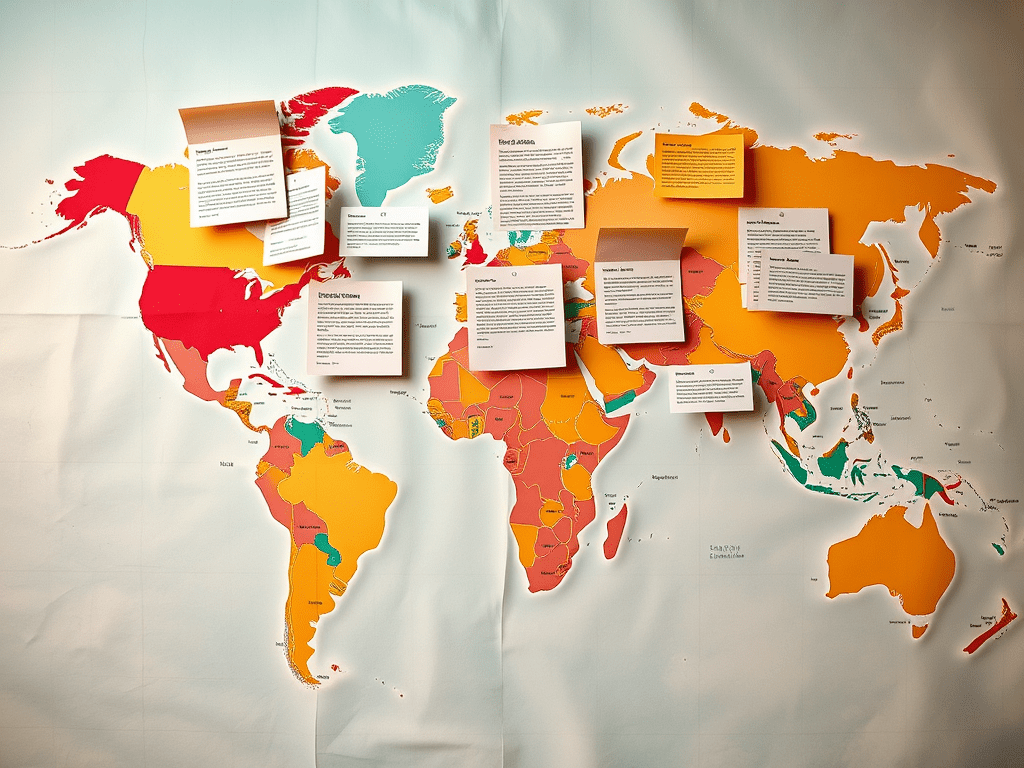
You may spend hours perfecting your CV — but if your cover letter misses the mark, recruiters might never open it. The challenge? Cover letter expectations aren’t the same everywhere. As we showed in The Resume Trap: Why One CV Doesn’t Fit Every Country, application rules shift with each region — and what feels professional in one country may fall flat in another. A letter that sounds sharp and polished in London can come across as stiff in Toronto, while a meticulously structured German Bewerbungsschreiben might overwhelm a recruiter in New York.
This guide breaks down global cover letter rules, showing you what employers expect in different regions — and what to include, avoid, and adapt for international job applications.
Cover Letter Expectations by Region
United States & Canada
In North America, cover letters are often treated as optional, especially in fast-moving industries like tech where online application forms or LinkedIn profiles dominate. But in government, academia, and established corporate sectors, a missing letter can look careless.
- Length: one page maximum, 3–4 short paragraphs.
- Tone: professional but more conversational than in Europe — enthusiasm is welcome.
- Focus: answer one question — why this role, why this company, why now?
Tip: Recruiters dislike generic “Dear Hiring Manager” letters. Research the name when possible — personalization increases response rates.
United Kingdom & Europe
In much of Europe, cover letters are still non-negotiable. They show you respect process, structure, and detail.
- UK: Cover letters remain standard, especially in competitive fields like law, consulting, and media. Clarity and direct links to job criteria are expected.
- Germany: The Bewerbungsschreiben is essential. Formal, precise, and heavily structured. A proper subject line (Betreff) comes before the greeting. Errors in spelling, grammar, or layout can instantly disqualify an application.
- France: The lettre de motivation is required in many roles, especially public and administrative jobs. French recruiters expect more personal tone and motivation. In traditional settings, handwritten letters still appear.
- Scandinavia: Sweden, Norway, and Denmark keep things short and direct — but skipping the letter is rarely accepted.
Middle East & Asia
Expectations vary widely.
- Middle East: Multinationals (finance, education, oil & gas) follow Western-style norms and expect tailored cover letters. Local employers may emphasize the CV more heavily, though adding a letter rarely hurts.
- Japan: Instead of a Western-style cover letter, many employers prefer a shibō ryū — a formal statement of motivation. Extremely polite phrasing and proper format matter more than creativity. Some letters even include a personal seal (inkan).
- China & India: For many domestic companies, cover letters are optional. But for international firms and research institutions, they are required — and expected to follow Western formatting.
Australia & New Zealand
Here, cover letters are nearly always expected and often used as a screening tool.
- Length: one page, highly focused.
- Tone: clear and professional — enthusiasm is welcome, but avoid fluff.
- Focus: employers expect you to explicitly address the key criteria listed in the job description.
In Australia and NZ, skipping the cover letter can be enough to lose your place on the shortlist.
Global Differences at a Glance
| Region | Cover Letter Norm | Notes |
|---|---|---|
| US / Canada | Optional but useful | 1 page, tailored, professional but conversational |
| UK | Standard | Clear link between skills and advertised role |
| Germany | Essential (Bewerbungsschreiben) | Formal, structured, error-free |
| France | Essential (lettre de motivation) | More personal, sometimes handwritten |
| Scandinavia | Required | Short, direct, formal |
| Australia / NZ | Standard | Assessed directly against job criteria |
| Japan | Motivation statement (shibō ryū) | Replaces Western-style cover letter |
| China & India | Often optional | Expected for international/multinational roles |
| Middle East | Mixed | Multinationals expect them; local firms may not |
What to Include in Every Cover Letter
A strong cover letter has the same basic parts worldwide — but even the header layout differs by country:
- US / Canada → applicant details top left, date below, employer’s info next.
- UK → similar to US, but sometimes date appears top right.
- Germany → sender’s address top right, employer’s left, subject line (Betreff) before greeting.
- France → employer’s details often come first, then applicant’s, with city/date before greeting.
- Japan → extremely formal, sometimes with a seal/stamp.
- Middle East → both applicant and employer details usually aligned left.
Beyond layout, here’s what to always include:
- Header (as above).
- Greeting: Use a name when possible. Avoid “To Whom It May Concern” — outdated and impersonal.
- Opening: State the role, source of job ad, and a confident first line.
- Example: “I am applying for the Policy Analyst role at [Org], where my experience in data governance directly matches your team’s focus.”
- Body (2–3 short paragraphs):
- Connect skills + motivation to the job.
- Add 1–2 concrete examples.
- For academia/research: emphasize publications, grants, collaborations.
- For industry: stress measurable results, leadership, and impact.
- For NGOs/public sector: align with mission, values, or policy goals.
- Closing: Show enthusiasm, invite follow-up, and thank the reader.
- Signature: “Sincerely,” or “Best regards,” + full name.
What Not to Include
- Copying your CV word-for-word.
- Salary expectations (unless requested).
- Generic filler like “hard-working team player”.
- Unrelated certificates, photos, or personal details.
- Overlong text — more than one page is almost always too much.
Global Maximums by Sector
- Academia / Research → up to 1.5 pages is acceptable, especially when describing research interests or teaching philosophy.
- Industry / Corporate → one page maximum. Short, tailored, achievement-focused.
- Public Sector / NGOs → strict templates (e.g., UN Inspira, EU EPSO) often replace the traditional letter. Always follow platform instructions.
Common Mistakes Everywhere
- Using one template for every application.
- Overusing buzzwords (dynamic, innovative, motivated) without proof.
- Ignoring cultural tone (too casual in Germany, too stiff in Canada).
- Skipping the letter where it’s required.
Real Examples
- Germany vs US: A candidate sent a two-page Bewerbungsschreiben in Munich — perfect for German recruiters. When reused for New York, it felt rigid and was ignored.
- Australia vs Middle East: An applicant in Sydney tailored her letter line by line to the job description and got an interview. In Dubai, the same company culture favored a shorter letter paired with a detailed CV.
Quick Checklist
- Tailor to the role and country.
- Keep it to one page (except academia).
- Use concrete examples.
- Respect header and layout norms.
- ❌ Don’t copy your CV.
- ❌ Don’t use clichés.
- ❌ Don’t skip the letter if the culture expects one.
Your First Voice Matters
Your CV is the record. Your cover letter is the first voice they hear.
In North America, it may be optional. In Europe, it’s often decisive. In Asia and the Middle East, rules vary. But everywhere, a clear, concise, and culturally adapted letter sends one powerful signal: This person understands our work culture — and can adapt fast.
Read More
- The Resume Trap: Why One CV Doesn’t Fit Every Country Understand how CV expectations shift worldwide — and why one version won’t work everywhere.
- The Most Future-Proof Careers for the Next 50 Years Explore the jobs that will thrive — and the ones that will disappear — in the decades ahead.
- How to Immigrate to Canada in 2025 and Beyond with a Foreign Degree A full guide for skilled professionals navigating Canada’s immigration process.
- Top 10 Affordable Countries to Immigrate in 2025 Best options for families and skilled workers looking to build a new life abroad.