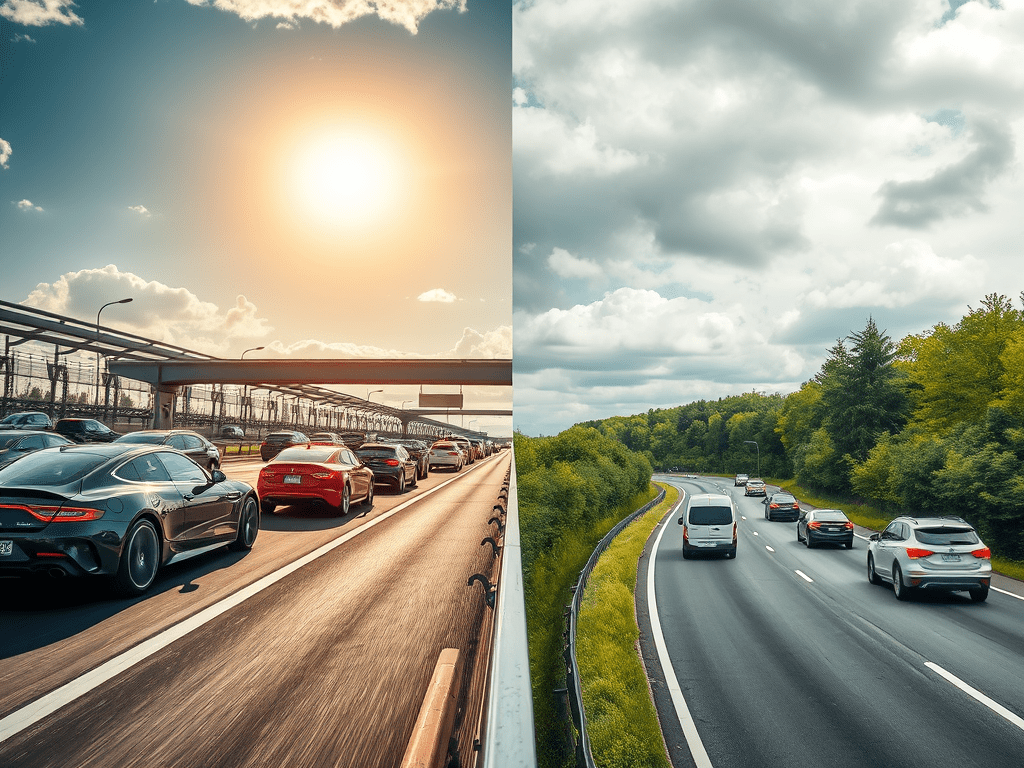
Some roads have no limits. Others barely let you pass 100 km/h. Which ones are truly safer?
The speedometer is universal. Whether you’re in Toronto, Madrid, Berlin, or Douglas on the Isle of Man, the dial promises 200 km/h or more. But the law? That depends on where you are.
In Germany, large stretches of the Autobahn remain free of speed limits. On the Isle of Man, tradition protects rural roads from restriction. In Canada, highways rarely exceed 100–110 km/h. Spain holds firm at 120 km/h, while Japan caps expressways at just 100 km/h.
This is the world’s speed divide: nations that trust drivers with freedom versus those that contain them with caution. And here lies the paradox — strict limits don’t always mean safer roads, and unlimited ones don’t always cause chaos.
Germany: The Benchmark of Unlimited Speed
The Autobahn is Germany’s signature gift to the driving world. Around 70% of its network has no general limit, and cars cruise comfortably at 160–200 km/h. Yet fatality rates per kilometre driven are lower than on many American or Canadian highways.
The secret is structure: flawless engineering, strict driver licensing, and cultural discipline. Speed is free, but recklessness is punished. Overtake only on the left, respect distance, and check mirrors — these rules are enforced by both law and culture. Germany proves that freedom paired with responsibility can be safer than rigid control.
The Isle of Man: Tradition Over Limits
Nestled in the Irish Sea, the Isle of Man has no national speed limit outside its towns. It’s famous for the TT motorcycle race, run on public roads, and locals defend unlimited driving as part of their heritage.
The roads are narrower and riskier than Germany’s, but the principle is the same: freedom only works when paired with respect. The Isle of Man stands as a cultural counterpoint to the cautious grids of Canada or Spain.
Canada: Caution by Design
Canada’s highways are among the slowest in the developed world. Québec enforces 100 km/h, most provinces cap at 110, and experiments with 120–130 were rolled back after higher crash rates.
Cities are filled with all-way stops, not roundabouts. This creates predictability but also a frustrating stop–go rhythm. Enforcement is strict: distracted driving fines begin at $300–$600 in Québec, winter tires are mandatory, and “stunt driving” can mean roadside suspensions and vehicle impoundments.
Yet Canadians still buy vehicles that laugh at these limits: Ford F-Series trucks, Toyota RAV4s, Honda CR-Vs, Teslas, BMWs, and Mercedes-Benz models. The paradox is cultural — cars are not only transport but symbols of safety, power, and status, even if the law never allows their full potential.
Spain: Slower Limits, Faster Desires
Spain holds firm at 120 km/h on its motorways. Since 2021, many urban streets are capped at 30 km/h. Speed cameras are everywhere, fines steep, and a points system strips reckless drivers of their licences.
Yet Spaniards drive fast. Many sprint at 150–160 km/h between radars, then slam brakes before enforcement zones. Popular cars reflect practicality (Hyundai Tucson, Seat Arona, Peugeot 2008) but prestige imports and luxury SUVs remain coveted. As in Canada, rules are strict but behaviours bend around them.
Other Global Case Studies
- United States: Highways usually capped at 105–120 km/h, with Texas allowing 85 mph (137 km/h). Yet fatalities average ~12 per 100,000 people — far higher than Europe. Distracted driving, alcohol, and weak training are key culprits.
- Montana (1995–1999): Briefly had no daytime limit under “reasonable and prudent.” Fatalities spiked by 30%+ before hard limits were reinstated. Freedom without culture or design turned chaotic.
- Japan: Expressways capped at 100 km/h. Fatalities remain low (~2.6 per 100,000) thanks to cultural discipline, zero tolerance for drunk driving, and high compliance. Here, low limits work because society obeys them.
- Middle East (UAE, Qatar, Saudi): Highways at 120–140 km/h, but fatalities remain high (10–18 per 100,000). Modern roads and harsh penalties coexist with reckless prestige driving.
- Australia’s Northern Territory: Tested unlimited stretches; accidents rose, limits reinstated at 130 km/h.
Other Asia and Africa: How the Divide Plays Out
Asia
- Singapore (very low limits, very low deaths): Expressways capped at 90 km/h (70–80 in tunnels). Fatality rates among the lowest in the world (~2.3–2.4). Proof that design + compliance = safety.
- South Korea (moderate limits, improving safety): 100–110 km/h, select corridors at 120. Fatality rate ~5.3. Better infrastructure and enforcement are steadily lowering risks.
- India (higher caps, high risks): Up to 120 km/h on new expressways, but national fatality rate ~14–15 per 100,000. Mixed traffic and enforcement gaps overwhelm posted rules.
Africa
- South Africa (120 km/h freeways, high fatalities): Despite modern freeways, death rates ~24–25 per 100,000. Enforcement is weak, speeding and reckless driving common.
- Kenya (110 km/h highways, among the worst rates): Fatalities ~28 per 100,000 — one of the highest globally. Poor enforcement, infrastructure gaps, and unsafe vehicles compound risk.
- Morocco (120 km/h autoroutes, mid-level rates): ~9.5 per 100,000. Autoroutes are relatively safe, but urban roads and two-wheelers drive up the national toll.
What this shows: Asia offers both very safe low-limit models (Singapore) and mid-level improvers (Korea), while India exposes the gap between modern highways and inconsistent safety culture. Africa highlights the hardest truth: limits on paper mean little without strong enforcement, safe infrastructure, and driver discipline.
Data Spotlight: The Speed Divide in Numbers
| Country/Region | Highway Limit | Deaths (per 100k) | Pattern |
|---|---|---|---|
| Germany (Autobahn) | Unlimited on ~70% | ~2.0–2.5 | Safe: discipline, training, design |
| Canada | 100–110 | ~5.0–5.5 | Distraction, winter, impatience |
| Spain | 120 | ~3.6 | Cameras work, but speeding bursts |
| United States (avg.) | 105–120 | ~12 | High distraction, weak training |
| Montana (1995–1999) | No daytime limit | Fatalities ↑ 30%+ | Freedom without culture = chaos |
| Singapore | 90 (70–80 in tunnels) | ~2.3–2.4 | Ultra-low + strict enforcement |
| South Korea | 100–110 (120 trial) | ~5.3 | Steady improvement via design |
| India | Up to 120 | ~14–15 | High fatalities despite modern roads |
| South Africa | 120 | ~24–25 | High speeds + low compliance |
| Kenya | 110 (dual), 100 (single) | ~28 | Among the world’s highest |
| Morocco | 120 | ~9.5 | Safer autoroutes, risky cities |
How to read it: Germany’s “unlimited” roads are safer per km than Canada’s “cautious” ones. Singapore proves low limits work with compliance. India and much of Africa show that posted limits mean little without infrastructure and discipline. Montana proves freedom without culture leads to chaos.
Harsh Weather, Harsh Penalties — But Habits Die Hard
Canada and Spain are strict on paper and harsh in climate.
- Canada: Snowstorms, ice, freezing rain. Fines among the toughest in North America. Yet habits like rolling stops, texting at green lights, and sudden speed bursts between cameras persist.
- Spain: Heavy rains, fog, and heat. Despite radars, drivers accelerate hard then brake before enforcement zones.
- Germany: Snow in Bavaria, rain in the north. Yet drivers remain disciplined even at 200 km/h. The weather is harsh, but the culture is stricter.
The paradox is sharp: limits and penalties can’t fix human shortcuts if discipline isn’t ingrained.
Conclusion
The world’s roads reflect two philosophies:
- Unlimited trust — as in Germany’s Autobahn and the Isle of Man, where freedom is balanced by training and respect.
- Controlled caution — as in Canada, Spain, much of Asia and Africa, where strict limits try to contain risk but can’t fully cure distraction or impatience.
The paradox is that unlimited roads sometimes prove safer than limited ones. Canada and Spain show that harsh penalties and cautious laws don’t guarantee discipline. Germany proves that discipline and design can make freedom work. Africa shows the hardest truth: limits without infrastructure or enforcement are just numbers on signs.
The World’s Speed Divide is not really about the number on the sign. It’s about culture, training, infrastructure, and the eternal balance between freedom and control.
Read More from Curianic
- Private Jet Economy: Who Controls the Skies, and Who Really Profits?
Explore how private jet travel reflects wealth, power, and who really benefits behind the scenes. - Canadian Snowbirds in 2025: What Has Changed and What You Must Know
A closer look at the new rules, challenges, and lifestyle shifts for Canadians spending winters abroad. - The Real Cost of Living Abroad: Taxes, Culture, and Surprising Price Gaps Worldwide
Moving abroad isn’t just about adventure — the cultural and financial gaps may surprise you. - Top Tourist Destinations with Hidden Risks for Women and Families (2025 Guide)
Beautiful destinations aren’t always what they seem — uncover the risks travelers often overlook.