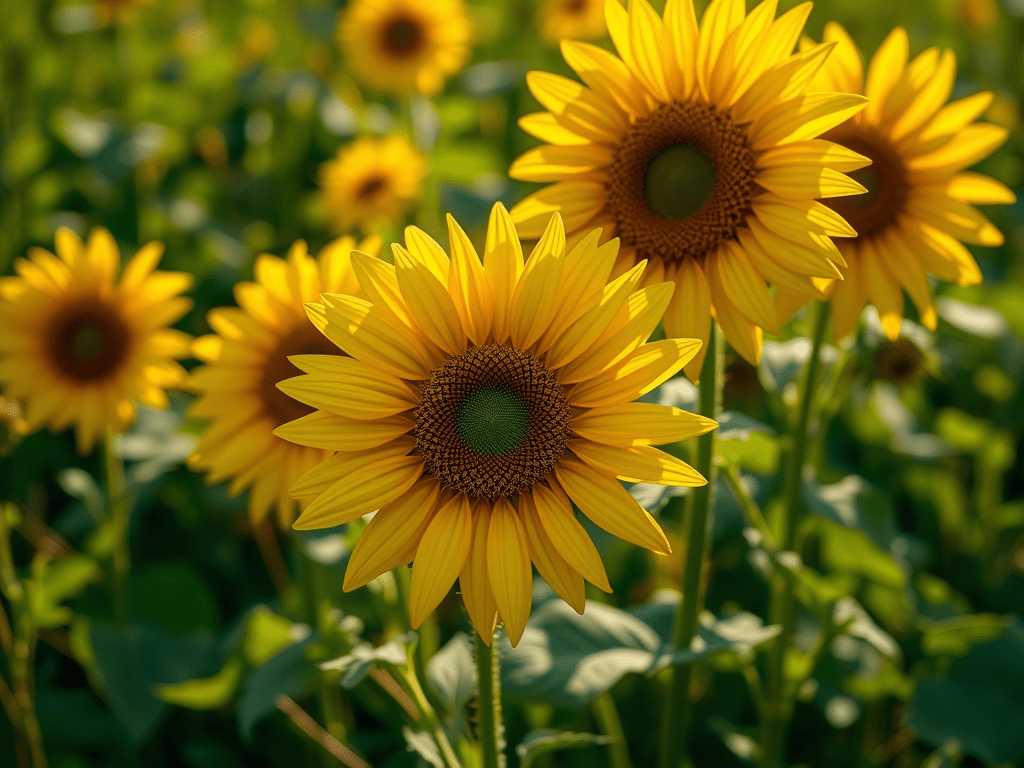
The sunflower — Helianthus annuus — is far more than a cheerful bloom turning toward the light. Behind its golden crown lies a long journey through time, from sacred Native American fields to the masterpieces of European art.
A member of the Asteraceae family, the sunflower can grow over three meters tall and carries thousands of florets that each produce a seed. Its radiant head follows the path of the sun — a movement known as heliotropism — and typically blooms from mid-summer through early autumn, marking one of nature’s brightest displays of renewal.
Roots in Ancient America
Archaeological evidence shows that sunflowers were first domesticated in North America over 3,000 years ago, making them one of the earliest cultivated plants on the continent.
Indigenous peoples across what is now the United States and Mexico grew sunflowers for food, oil, medicine, and ceremony.
- The seeds were roasted and ground into flour or mixed with cornmeal.
- The oil was used for cooking and skin protection.
- The stalks and petals had ritual roles, symbolizing the cycle of life, light, and nourishment.
The sunflower’s practicality and spiritual meaning made it a central figure in early agricultural societies — a crop that fed both the body and the spirit.
Across Oceans and Empires
In the early 16th century, Spanish explorers carried sunflower seeds back to Europe after encountering them in the Americas. By the 1700s, sunflowers were being cultivated across Spain, Italy, and Russia, admired first for their decorative beauty and later for their industrial potential.
In Russia, under Peter the Great (1682–1725), sunflower oil became popular partly because it was the only oil permitted during Lent by the Orthodox Church. By the 19th century, vast sunflower fields spread across Eastern Europe, transforming the plant into both a symbol of rural life and an important agricultural export.
The plant’s return to North America centuries later — now as an oil and ornamental crop — marked a full historical circle.
A Symbol Reaching Beyond Nature
Across civilizations, the sunflower has been seen as a mirror of the sun, symbolizing faith, vitality, and renewal.
- For the Aztecs, it represented the power of the solar god Tonatiuh.
- For Christian Europe, it came to represent steadfast faith — turning always toward divine light.
- In modern symbolism, it expresses joy, resilience, and clarity, qualities that transcend borders and languages.
Its golden geometry — the perfect spiral of its seeds — fascinated mathematicians and artists alike, reflecting nature’s innate harmony through the Fibonacci sequence.
Long before it became a subject of art, the sunflower was sought as a decorative flower, brightening European gardens and homes with its solar form.
Sunflowers in Art: A Language of Light
The sunflower’s path into art history is inseparable from human fascination with light itself.
Vincent van Gogh (1853–1890) immortalized it in his legendary Sunflowers series (1888–1889), where yellows became metaphors for friendship, energy, and emotional truth. Van Gogh saw the flower not as decoration but as a portrait of life itself — full of growth, decline, and rebirth.
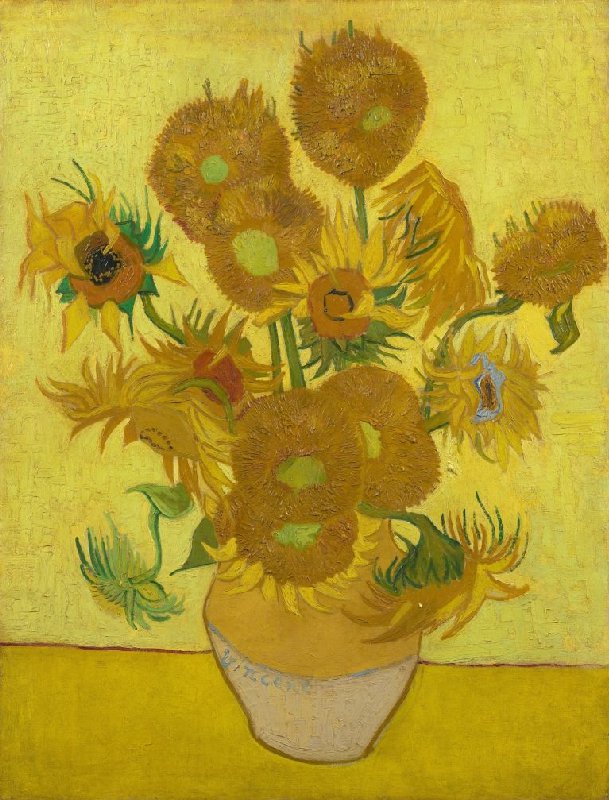
Vincent van Gogh, Sunflowers, 1889
Oil on canvas, 95 × 73 cm
Van Gogh Museum, Amsterdam (Vincent van Gogh Foundation)
Painted in Arles, this masterpiece reflects van Gogh’s devotion to light, warmth, and the life of nature — a vision that continues to inspire artists worldwide.
Other artists also found meaning in its vibrant simplicity:
- Claude Monet (1840–1926) painted sunflowers as studies of natural light and motion.
- Diego Rivera (1886–1957) depicted them as emblems of labor and earth’s abundance.
- Georgia O’Keeffe (1887–1986) explored their form as bold abstractions of color and texture.
The sunflower’s appearance across centuries of art demonstrates its enduring power as a bridge between the natural and the spiritual, the tangible and the eternal.
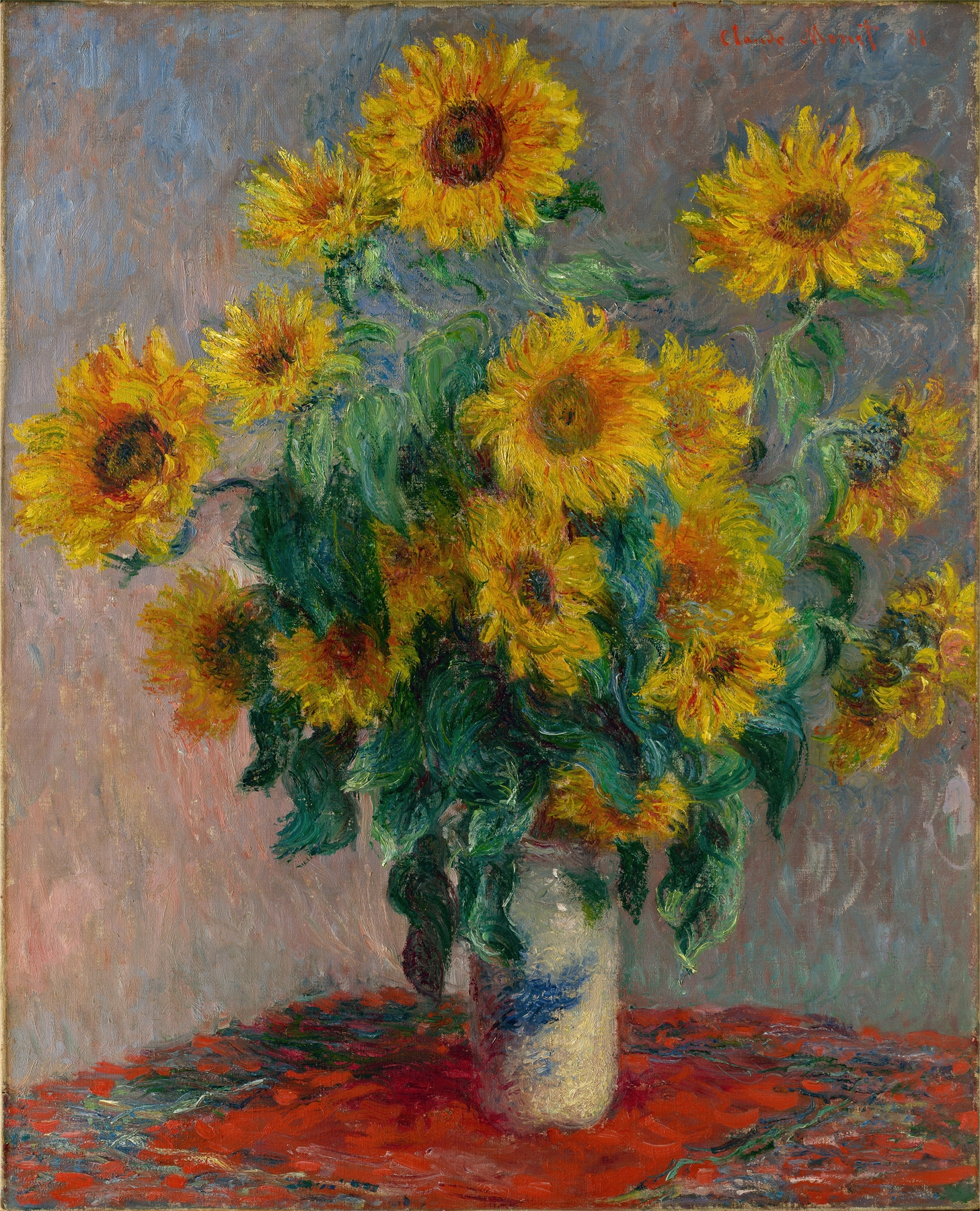
Claude Monet, Bouquet of Sunflowers, 1881
Oil on canvas, Metropolitan Museum of Art, New York (public domain via Artvee)
Painted in Monet’s home at Vétheuil, this sunlit arrangement reveals his fascination with color and movement — a moment of still life transformed into pure light.
Science and Art in Harmony
Beyond its beauty, the sunflower embodies a quiet mathematical perfection. Its florets are arranged in interlocking spirals — one clockwise, one counterclockwise — reflecting the Fibonacci pattern, a natural law of efficiency and balance.
This has inspired architects, designers, and even data scientists to see the sunflower as a symbol of nature’s code — where art, mathematics, and biology meet.
A Modern Symbol of Hope
In our own century, the sunflower continues to rise as a global emblem of peace, resilience, and environmental awareness.
It adorns protest banners, sustainability campaigns, and climate murals — most recently becoming a symbol of solidarity and hope in Ukraine and beyond.
From Indigenous farmlands to the walls of museums, from fields of gold to digital screens, the sunflower’s story is one of enduring brilliance — a living dialogue between earth and imagination.
Healing, Harvest, and Global Roots
Beyond its beauty and symbolism, the sunflower remains a vital source of nutrition, medicine, and economic importance.
Its seeds, rich in protein and vitamin E, are roasted and eaten as snacks in many cultures — from North America and Eastern Europe to the Middle East and China.
In Russia, Ukraine, and Poland, they are known as semechki and enjoyed during walks or social gatherings.
In Turkey, Syria, Lebanon, and Iran, they are served with black tea, a custom dating back centuries.
In China, roasted sunflower seeds (guāzǐ) accompany tea, travel, and festivals, while in North America, they have become a familiar snack at sporting events and outdoor gatherings.
Sunflower oil, one of the world’s healthiest plant oils, is used in both cooking and skincare. Traditional remedies also relied on sunflower petals, roots, and leaves to ease fever, inflammation, and respiratory discomfort.
Sunflowers are now also used in environmental restoration, capable of absorbing heavy metals from contaminated soils — a process known as phytoremediation — proving that their strength reaches far beyond beauty.
Today, Ukraine, Russia, Argentina, and China lead global oilseed production, while the United States, France, and the Netherlands are major producers of the ornamental flower industry.
Fresh sunflowers are widely sold in flower shops worldwide, admired for their longevity, bold color, and symbolism of happiness and strength. They are often chosen in bouquets and floral arrangements to express optimism, loyalty, and gratitude.
From ancient medicine to modern design, from healing to home décor, the sunflower continues to serve both body and soul — a radiant union of art, earth, and human ingenuity.
Read More from Curianic
- The Story of the Rose Plant: From Ancient Gardens to Modern Perfumes
- Why the Wealthy Spend Millions on Paintings, Portraits, Antiques, Jewels and More
- The Drowning of a Crown: Ludwig II and the Empire That Feared a Dreamer
- Luxury or Burden? The True Cost of Pools, Terraces, Fireplaces, and Saunas in Modern Homes