The Name Born of the Wind
Long before gardens were named and flowers catalogued, there was a blossom that moved at the whisper of the breeze.
The ancient Greeks watched its trembling petals and called it Anemōnē — from anemos, meaning wind. That is how Anemone coronaria, the Wind Flower, received its name.
In Arabic it is known as شقائق النعمان, a name bound to legend and poetry.
Across the Eastern Mediterranean — Syria, Lebanon, Palestine, Jordan, Turkey, Greece, and Cyprus — the wild red anemone blooms each spring, opening with the morning light and closing at dusk.
Centuries later, through cultivation in Europe, gardeners created white, pink, violet, and blue varieties, but the red remains the original and most ancient color, born of the land itself.
From the Mediterranean Hills
The anemone’s homeland is the heart of the Mediterranean basin, a region where history and sunlight meet.
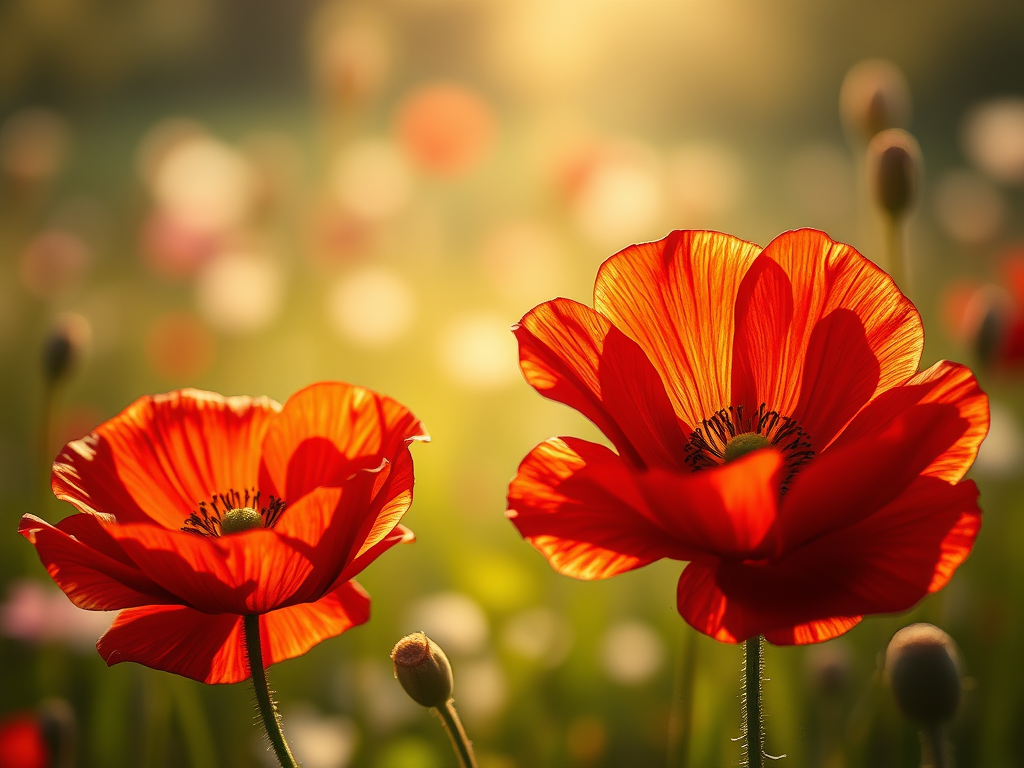
In spring, fields across Syria and the Levant glow with red anemones, their petals soft as silk and bright as flame.
In neighboring lands — Greece, Turkey, Cyprus, and southern Italy — the same wild species grows, a living link between civilizations that once shared sea and sky.
The Ancient Chronicle of a Flower
The story of the anemone begins more than two thousand years ago.
The Greek naturalist Theophrastus (371–287 BC), known as the Father of Botany, was the first to describe this delicate plant, noting how it “opens with the wind and closes with the night.”
In Greek mythology, it was said to have sprung from the blood of Adonis, the beloved of Aphrodite — his death giving birth to a flower of sorrow and eternal return.
For that reason, the anemone became a symbol of love lost and life renewed.
When the Romans embraced it, they planted it near tombs and temples, believing it could protect the soul’s journey beyond death.
Through Phoenician and Roman trade routes, its seeds traveled west, reaching Cyprus, Sicily, and the coasts of Italy, France, and Spain — carried by merchants, wind, and time.
A Traveler Across Empires
The anemone grew wherever civilization bloomed.
In the Byzantine and Islamic worlds, it appeared in mosaics, pottery, and illuminated manuscripts as a mark of divine creation.
Under the Ottoman Empire, its likeness adorned Iznik tiles and silken fabrics, a balance of beauty and melancholy.
During the Renaissance, botanists such as Matthiolus and Cesalpino classified it in Italy, while Louis XIV’s gardens in France displayed its cultivated colors with royal pride.
By the seventeenth century, it had reached the gardens of England, the Netherlands, and Spain, where new varieties were bred — yet none rivaled the wild red flower of the East, still blooming freely each spring across the Syrian plains.
A Flower of the Mediterranean
In Italy, wild anemones still color the meadows of Sicily and Liguria; in southern France, they fill the air with gentle scent near Provence and the Riviera.
In Spain, they brighten Andalusian hillsides beneath olive groves.
From Damascus to Seville, from Athens to Marseille, this single flower threads the cultures of the Mediterranean like a red ribbon of spring.
A Symbol Written in Blood and Legend
In some ancient tales, it was believed that when a warrior fell on the battlefield, his blood turned into red anemones — a mythic way of saying that courage gives life to beauty, and that the earth itself remembers the brave.
This belief mirrors both Greek legend and Arabic poetry, where the red anemone stands for martyrdom and valor.
Though the story is poetic rather than literal, it reveals how deeply the flower became tied to the themes of sacrifice, love, and rebirth that unite human history.
A Muse of Artists and Memory
Painters across centuries have been drawn to the anemone’s light:
- Claude Monet (1840–1926) painted the rolling fields of poppies as symbols of harmony and grace — see Poppy Field (1873) (also known as Poppy Field at Argenteuil), oil on canvas, The Metropolitan Museum of Art.
- Henri Matisse (1869–1954) captured the anemone’s vivid rhythm in Bouquet of Anemones (Bouquet d’anémones) — oil on canvas, painted in spring 1918 and now part of The Barnes Foundation collection in Philadelphia.
- Georgia O’Keeffe (1887–1986) portrayed the flower’s form as an emblem of strength and sensitivity in Red Poppy VI (1928)— a luminous study in color and form that captures the same vibrant power found in nature’s wild anemones.
Its colors spoke the language of emotion — red for life, white for purity, blue for peace, violet for longing.
Few flowers have inspired both scientific study and spiritual reflection so completely.
The Red Emblem of Remembrance
After World War I, red fields of Flanders — echoing the color of the anemone — inspired the Remembrance Poppy, worn each November 11 in England, Canada, and the Commonwealth to honor those who died in war.
Although the poppy and the anemone are different species, they share a single spirit: a red flower of remembrance, blooming from sorrow into peace.
Thus, a flower born in the Eastern Mediterranean came to symbolize memory for the entire modern world.
Healing Traditions and Everyday Life
Beyond its legends, the anemone holds a quiet place in folk medicine.
In Syria and Anatolia, its petals were used to soothe pain and calm the nerves, earning the name “the flower of rest after sorrow.”
In rural villages, its seeds are roasted and eaten like nuts, often served with tea or coffee, a humble yet enduring custom.
Though mildly toxic when raw, it was long valued as a gentle sedative and anti-inflammatory remedy, a reminder that beauty and healing often bloom together.
Modern Cultivation and Legacy
Today, the anemone is cultivated across Italy, France, the Netherlands, Turkey, and Israel, grown for floral markets, perfumes, and art.
Yet in the Levant, it still blooms wild each spring, untouched by commerce or time — the same red pulse of nature that once inspired myth and memory.
A Flower Without Borders
The anemone’s journey is more than botanical; it is human.
Born from wind and myth, carried by empires and art, it continues to connect East and West, ancient and modern, grief and renewal.
Every spring, when its red petals return to the sunlight, they remind us of the same eternal truth —
that from sorrow comes beauty,
that from death comes life,
and that even a flower moved by the wind can leave a mark upon eternity.