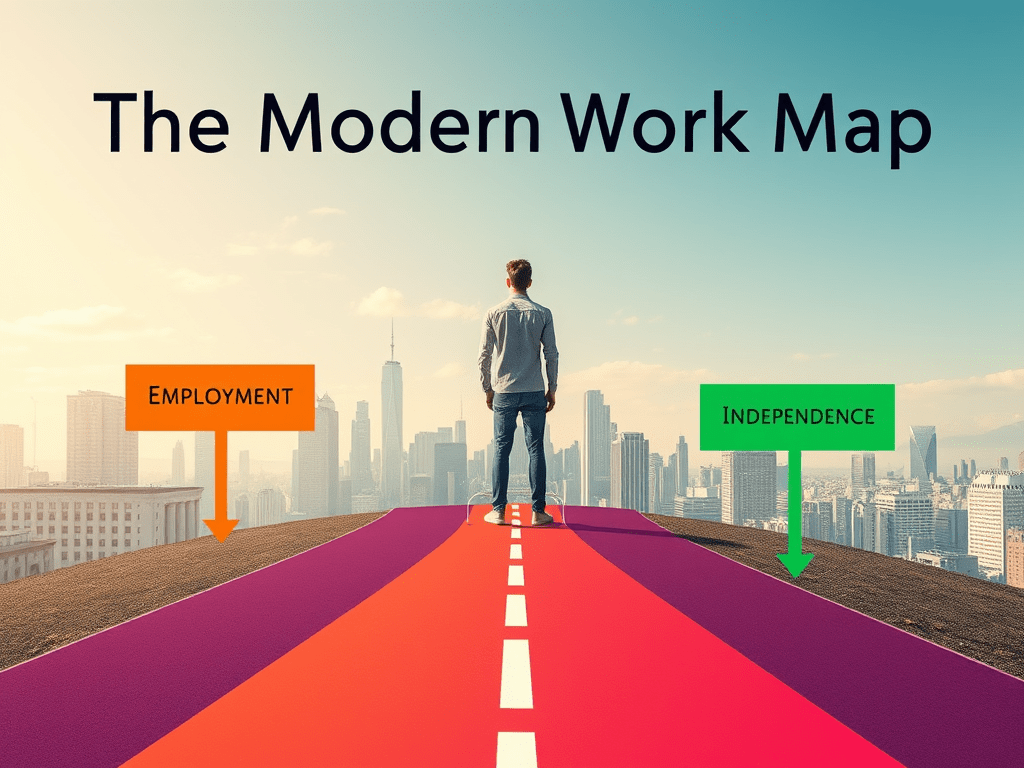
I. The Career Illusion
Most people choose jobs by opportunity, not by fit. They say yes because a company wants them, or because the salary looks stable. But sooner or later, something breaks: burnout, boredom, or the quiet voice that says, “I don’t belong here anymore.”
Work today is not just about earning — it’s about alignment between personality, freedom, and security. To build a sustainable career, you must know who you are at work: the builder, the explorer, the protector, or the rebel.
II. The Four Core Work Archetypes
1. The Builder — The Full-Time Employee
Builders like structure. They thrive in systems where progress is visible: promotions, teamwork, annual reviews.
They work well under leadership because they see hierarchy as an ecosystem — not oppression but order.
Their satisfaction comes from belonging and mastery within boundaries.
Advantages: stability, benefits, clear growth path, team support.
Disadvantages: limited freedom, dependence on external validation, exposure to office politics.
Typical conflict: over time, builders may feel creativity dying or individuality dissolving in the system.
2. The Explorer — The Freelancer
Explorers live on curiosity and autonomy. They need projects that change, clients that challenge them, and schedules they control.
But with freedom comes uncertainty. Freelancers must constantly prove their value and manage their own finances, marketing, and focus.
Advantages: independence, flexibility, endless learning.
Disadvantages: income instability, lack of team belonging, risk of isolation.
Typical conflict: excitement turns to anxiety when freedom feels like chaos — especially if savings or consistency are weak.
3. The Strategist — The Independent Consultant or Specialist
This is a mature freelancer who transforms expertise into a personal brand.
Strategists don’t sell time — they sell results. They operate like a one-person firm, choosing clients selectively.
Advantages: authority, higher income potential, creative control.
Disadvantages: administrative burden, constant pressure to deliver excellence.
Typical conflict: perfectionism — the constant fear that one mistake could destroy reputation.
4. The Protector — The Public or Government Professional
Protectors are drawn to stability, rules, and public value. They believe in systems that outlast them — schools, ministries, hospitals.
They work best where procedures matter more than competition.
Advantages: predictable schedule, benefits, societal contribution.
Disadvantages: bureaucracy, limited innovation, slow recognition.
Typical conflict: frustration with routine and inability to implement new ideas quickly.
III. The Invisible Fifth Type — The Hybrid
Modern life rarely fits one box. The new professional might teach part-time, freelance part-time, and consult occasionally.
Hybrid workers design careers around rhythm, not roles. They adapt seasonally — more freelance in summer, more structured in winter.
Advantages: variety, resilience, personal control.
Disadvantages: blurred boundaries, constant transition, scattered focus.
Typical conflict: guilt or exhaustion from “always switching identities.”
IV. The Financial Models Behind Each Path
Understanding the money logic of your work type prevents emotional exhaustion later.
- Full-Time: predictable income, employer-covered taxes and benefits. Limited scalability.
- Freelance: irregular income but infinite ceiling. Requires accounting discipline and emergency savings.
- Consulting / Independent: high-value projects, but income cycles. Must manage contracts, taxes, and branding.
- Public Sector: stable but slow-growing salary; strong pension.
- Hybrid: diverse income sources but high administrative complexity.
A career collapse often starts with ignoring your financial tolerance. Some minds need steady pay; others need scalable reward.
V. When to Switch — The Psychology of Timing
The hardest part of any professional life is recognizing when stability has become stagnation or when freedom has turned into fatigue.
Transitions are rarely logical — they begin as emotional friction: resentment toward a boss, dread before Monday, or the feeling that your energy no longer fits the place you work.
1. Emotional Signs
- You start to feel resentful instead of challenged.
- You notice yourself counting hours instead of creating value.
- You admire others’ paths more than your own.
These are not random moods; they are psychological notifications that your current model no longer supports your growth.
2. Professional Signs
- You have mastered your environment and stopped learning.
- You solve problems beyond your pay grade yet remain under authority.
- You’re doing “shadow work” — planning your next career during office hours.
At this stage, staying becomes riskier than leaving.
3. Financial Signals
Switching work types requires economic foresight.
Before quitting employment, build at least six months of financial buffer and test freelance or consulting work in parallel.
Before returning to employment, recalculate your lifestyle cost and evaluate if stability will actually lower your stress — sometimes it doesn’t.
4. Identity Clues
When your role feels like a costume — when meetings drain you, clients irritate you, or your ambition dissolves — your identity has evolved faster than your environment.
That’s the real moment to switch.
Transitions are not betrayals of who you were; they are updates to who you have become.
5. The Emotional Arc of Leaving
Every career shift carries grief.
Leaving a job can feel like ending a relationship — a mix of relief, fear, and nostalgia.
Understanding that emotion helps you exit with dignity instead of anger.
Growth begins the moment you accept that discomfort is data.
VI. The Human Conflicts Behind Career Choices
Behind every professional decision lies a personal battle — between safety and freedom, ego and peace, ambition and fatigue.
These conflicts decide not just how we work, but who we become through our work.
1. The Fear of Dependence vs. the Fear of Isolation
Some people suffocate under control; others crumble without guidance.
The employee who hates having a boss often discovers they are not lazy — they simply need creative sovereignty.
Meanwhile, the freelancer who longs for stability learns that independence without structure can feel like exile.
The real maturity comes from knowing which fear hurts less — instability or submission — and choosing accordingly.
2. The Illusion of Success
Titles and salaries create emotional traps.
A high position in a company can mask emptiness; self-employment can hide exhaustion behind the word freedom.
Every work form carries its own ego drug — recognition, status, followers, or profit.
True balance begins when you measure success not by external approval but by internal calm: the feeling that your work rhythm fits your mental architecture.
3. The Conflict Between Mastery and Mobility
Many professionals feel torn between deepening one skill and exploring new paths.
Full-timers may crave reinvention; freelancers may crave routine.
But this is not confusion — it’s growth. It’s the psyche signalling the need to evolve.
Ignoring it leads to quiet resentment; honouring it opens the next chapter of your professional identity.
4. The Relationship Archetype
Work mirrors personal relationships.
Some personalities are “long-term partners” — loyal, patient, steady.
Others are “serial innovators” — they love beginnings and hate maintenance.
Neither is wrong; the tragedy is pretending to be one while being the other.
Know your attachment style at work: do you bond with institutions or with ideas?
5. The Moral Conflict
Especially in the private sector, many professionals reach a point where they ask: “Am I building something that matters?”
Purpose becomes the new currency.
Those who ignore this question eventually lose motivation, even if pay increases.
The human mind resists meaningless repetition; it seeks impact as proof of existence.
6. The Deeper Equation — Ego, Fear, and Freedom
Every work mode is a reflection of ego, fear, and freedom.
- Ego: Do I need recognition or results?
- Fear: Do I fear instability or obedience more?
- Freedom: Do I want space or structure?
The reason people stay too long in wrong jobs is emotional debt — comfort, guilt, or fear of losing identity.
That’s why quitting a job often feels like ending a relationship: you’re breaking an internal contract.
Recognizing this emotional cost doesn’t make you weak — it makes you conscious.
Once you understand why you stay, you reclaim the power to leave with clarity instead of chaos.
VII. Designing Your Work Life Like an Operating System
The goal is not to “find the perfect job.” It’s to engineer your personal work rhythm.
Some thrive in five-day office structures; others perform best on short, high-intensity projects followed by rest.
Balance doesn’t come from external design — it comes from knowing your mental fuel source:
- Are you powered by stability, challenge, autonomy, or contribution?
Once you know that, you can build your schedule, projects, and partnerships around it.
VIII. Success Is Fit, Not Fame
In the age of hybrid careers and remote work, success isn’t about being an employee or a founder.
It’s about being aligned: with your temperament, values, and tolerance for uncertainty.
If you hate having a boss, it’s not rebellion — it’s information.
If you crave a team after years alone, it’s not weakness — it’s recalibration.
The only failure is ignoring the signals that your work mode no longer matches who you’ve become.
Because the future belongs not to the flexible, but to the self-aware — those who understand why they work, how they work,* and where they work best.
Read More from Curianic
Continue exploring how identity, purpose, and modern economics redefine the meaning of work:
- Generation Z and the Future of Work: How Firms Must Adapt to Thrive— Why the youngest workforce demands authenticity, mental balance, and a redefinition of success.
- Leadership in the Age of Algorithms— How data-driven leadership is reshaping human judgment, trust, and decision-making in workplaces worldwide.
- The Death of the Human Interview: Why Online Hiring Fails the Best Candidates— A critical look at why automated recruitment often overlooks creativity, empathy, and true potential.
- Meaningful Work in a Noisy World: Redefining Success with Clarity— Why redefining success starts with understanding your energy, values, and sense of contribution.
- The Resume Trap: Why One CV Doesn’t Fit Every Country— How global hiring expectations shape opportunities and why personalization matters more than ever.
Each story builds on The Modern Work Map’s core question — not just where you work, but why and how you choose your path in a transforming world.