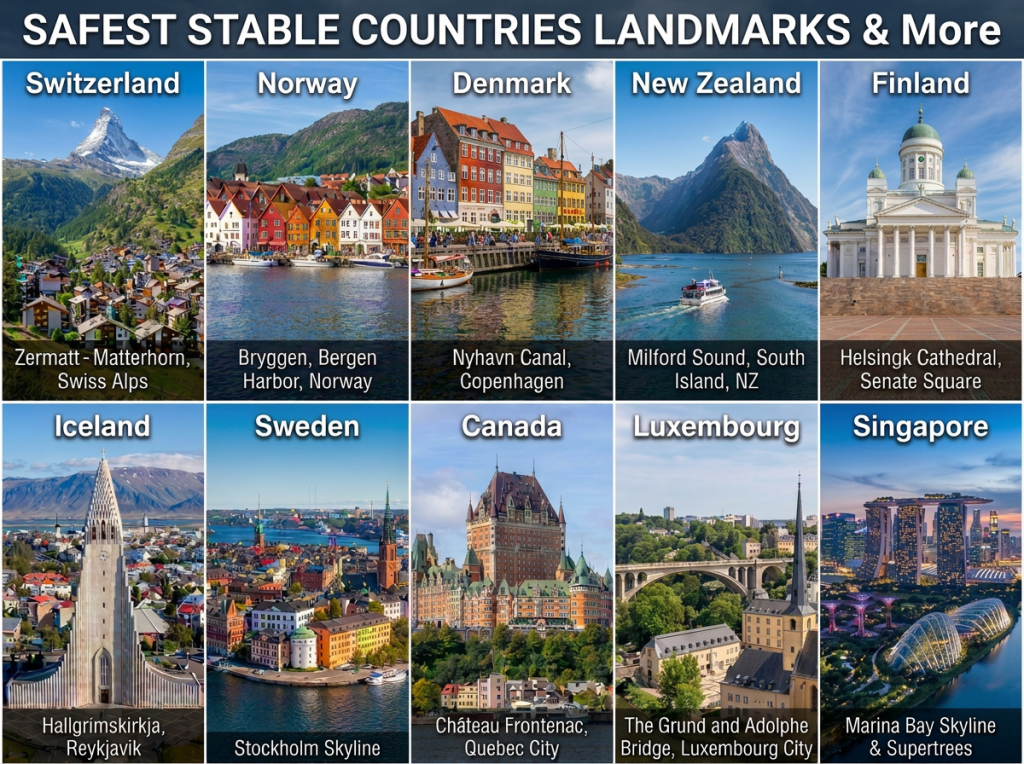
For centuries, people have searched for a place where peace, prosperity, and stability could endure across generations. While no nation has been entirely immune to political disagreements, economic downturns, or external threats, a small group of countries has consistently demonstrated remarkable resilience. Their success is not the result of luck, but of strong institutions, the rule of law, prudent economic management, and a culture that values social trust.
This article explores some of the world’s most stable countries, not as utopias, but as examples of how effective governance and long-term planning can create societies where citizens enjoy security, prosperity, and confidence in the future.
1. Switzerland: The Benchmark of Stability
Switzerland has long been regarded as one of the world’s most stable nations. Its policy of military neutrality, established centuries ago, has allowed it to avoid direct involvement in major international conflicts. Combined with a highly decentralized political system, strong democratic traditions, and one of the world’s most resilient economies, Switzerland has maintained exceptional political and financial stability.
The country’s banking, pharmaceutical, engineering, and technology sectors contribute to a diversified economy that has weathered global financial crises better than many larger nations.
2. Iceland: Peace Through Strong Institutions
Despite its small population, Iceland consistently ranks among the safest countries in the world. It has virtually no standing military, extremely low crime rates, transparent governance, and high public trust in institutions.
Following the global financial crisis of 2008, Iceland implemented significant reforms that strengthened its economy and restored public confidence, demonstrating remarkable resilience.
3. Singapore: Stability Through Strategic Governance
Since gaining independence in 1965, Singapore has transformed from a resource-poor island into one of the world’s leading financial and technological centers.
Its political continuity, strict enforcement of laws, world-class infrastructure, and efficient public administration have produced decades of economic growth and social stability. Although the country faces normal economic cycles, its institutions have consistently adapted to global challenges.
4. Norway: Prosperity with Long-Term Vision
Norway combines abundant natural resources with prudent fiscal management. Revenue from oil and gas has been invested through one of the world’s largest sovereign wealth funds, helping protect future generations from economic volatility.
High-quality public services, low corruption, strong democratic institutions, and comprehensive social welfare have made Norway one of the most stable societies in modern history.
5. Finland: Trust as a National Asset
Finland has repeatedly ranked among the happiest and safest countries in the world. Its education system, judicial independence, low corruption, and high social trust contribute to political continuity and economic resilience.
Even during periods of geopolitical tension, Finland has demonstrated an ability to adapt while preserving democratic stability.
6. Denmark: Consistency Over Centuries
Denmark enjoys a long constitutional tradition, efficient public institutions, and one of the world’s lowest corruption levels. Its balanced economy and strong social protections have enabled it to navigate global recessions with relatively limited disruption.
The country’s political culture emphasizes cooperation and consensus rather than polarization.
7. New Zealand: Geographic Advantage Meets Good Governance
New Zealand’s relative geographic isolation has reduced many external security risks. Combined with transparent governance, an independent judiciary, effective disaster management, and a diversified economy, the country consistently ranks among the world’s safest places to live.
8. Sweden: Stability Through Innovation
Sweden has maintained a long tradition of political stability, democratic governance, and economic resilience. Its economy is driven by innovation, advanced manufacturing, life sciences, and technology, while its strong welfare system and transparent public institutions contribute to high levels of social trust. Although Sweden has faced challenges such as inflation and migration-related debates, its institutions have consistently adapted without undermining the country’s overall stability.
9. Canada: A Stable Democracy with a Diversified Economy
Canada is widely recognized for its stable democratic institutions, independent judiciary, and peaceful political transitions. Its vast natural resources, strong financial sector, and diversified economy have enabled it to weather global economic downturns relatively well. While Canada has experienced periodic recessions and political disagreements, it continues to rank among the world’s safest countries due to its rule of law, low levels of corruption, and high quality of life.
10. Luxembourg: Small Nation, Exceptional Stability
Despite its modest size, Luxembourg has become one of Europe’s most stable and prosperous nations. It benefits from a highly developed financial sector, strong public finances, and close integration with European institutions. Political continuity, low corruption, and prudent fiscal management have allowed Luxembourg to maintain one of the highest standards of living in the world, making it a model of long-term economic and institutional stability.
Other Countries with Strong Stability Records
Austria, Netherlands, Japan, Australia, and Ireland
What Makes a Country Stable?
History suggests that lasting stability depends less on geography or natural resources than on the quality of institutions. Countries that remain stable across decades generally share several characteristics:
- Independent and reliable legal systems.
- Peaceful transfers of political power.
- Low levels of corruption.
- Diversified and resilient economies.
- Sound fiscal policies.
- High public trust in government.
- Strong education and healthcare systems.
- Respect for civil liberties and the rule of law.
An Important Reality
No country is permanently immune from political disagreements, economic recessions, or external shocks. Even the most stable nations have experienced financial crises, pandemics, geopolitical tensions, or periods of social debate.
What distinguishes the world’s most stable countries is not the absence of crises, but their ability to manage them without descending into prolonged instability.
Conclusion
History demonstrates that sustainable peace and prosperity are built on effective institutions rather than temporary economic success. Switzerland, Norway, Finland, Denmark, Iceland, Singapore, and New Zealand illustrate how responsible governance, transparent institutions, and long-term planning can foster societies that remain secure and prosperous across generations.
Rather than seeking a perfect country, history encourages us to identify the principles that enable nations to recover from adversity and continue providing their citizens with safety, opportunity, and confidence in the future.
Read More from CURIANIC
- Which Countries Worldwide Still Welcome Digital Nomads in 2025–2026?
- The Real Cost of Living Abroad: Taxes, Culture, and Surprising Price Gaps Worldwide
- What We Learn When We Cross Borders — Lessons That Stay
- Where to Travel in Summer 2026: Top Visa-Friendly Destinations for International Travelers (Part 1)
- Where to Travel in Summer 2026: More Visa-Friendly Destinations for International Travelers (Part 2)